


Blog > Where Mortgage Rates Stand Heading Into 2027, and Why the Spread Matters
Where Mortgage Rates Stand Heading Into 2027, and Why the Spread Matters
by
By Randy Richardson, Broker Associate, The 4th Right Team
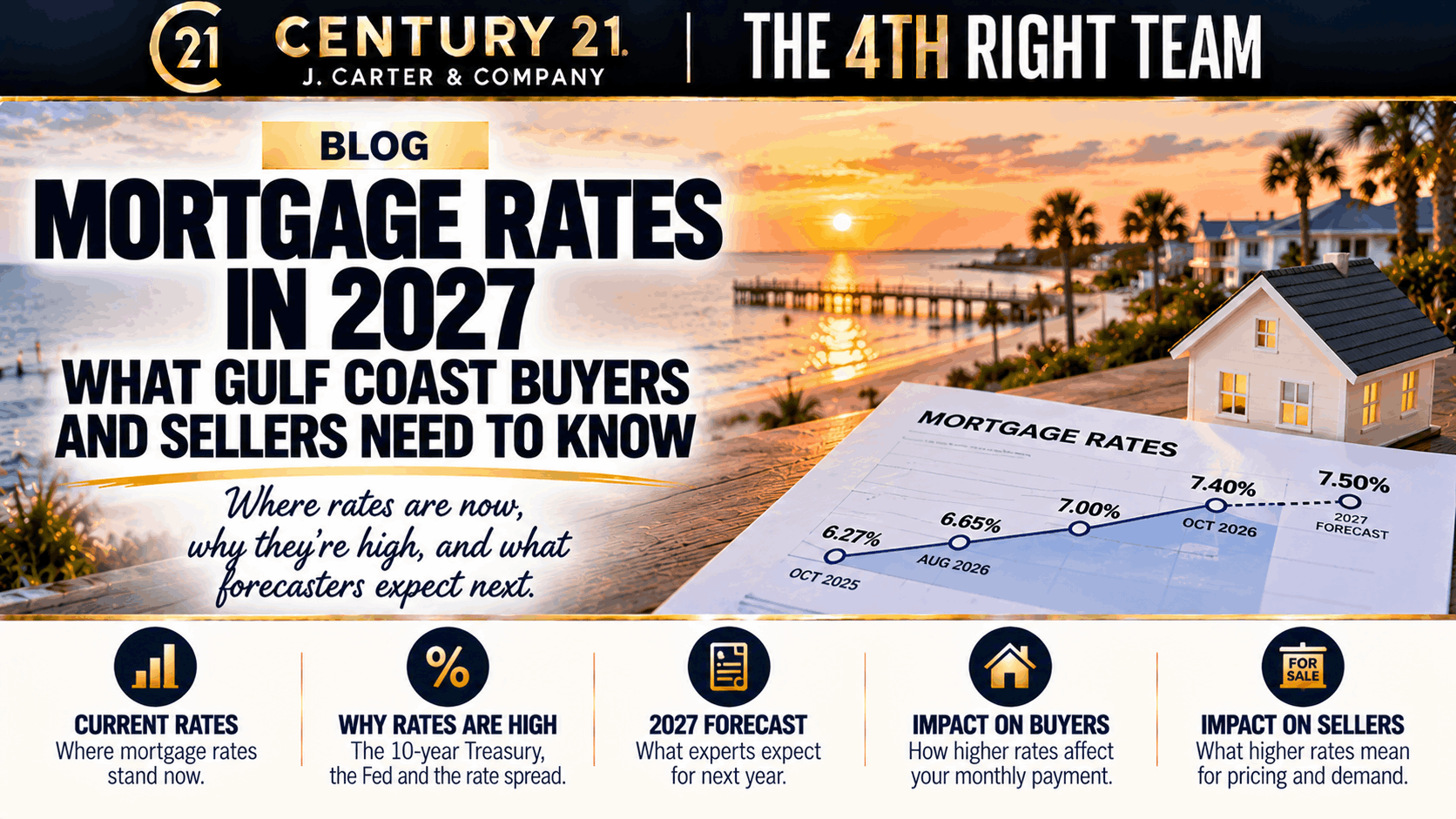
Quick Answer: As of October 15, 2026, Freddie Mac's average 30-year fixed mortgage rate was 7.40%, up from 6.27% a year earlier and the highest since November 2023. Two forces explain it: a 10-year Treasury yield above 5% and a wider-than-usual gap between Treasuries and mortgage rates. In October 2026, the Mortgage Bankers Association forecast rates above 7% through 2027, and Fannie Mae raised its 2027 forecast to 7.5%. For Mississippi Gulf Coast buyers, plan your budget around today's rate, not a hoped-for drop.
Where are mortgage rates right now?
High, and they got there fast. Freddie Mac's 30-year average rose for seven straight weeks, hit 7.40% the week of October 8, 2026, and held there October 15. That's more than a full point above the 6.27% average a year earlier.
Back in August, Freddie Mac's average was 6.65%. I wrote then about waiting for rates to drop. Instead, they climbed about three quarters of a point in two months.
Freddie Mac updates its average every Thursday. Check the newest number before you lock, and ask your lender what rate you'd actually get, since your credit, down payment and loan type all move it.
Why are mortgage rates so high heading into 2027?
Start with the 10-year Treasury yield. Mortgage rates track long-term bond yields more than the Fed's short-term rate. The 10-year sat at about 5.08% on October 20, 2026, after spending much of October above 5%.
The Fed is pushing in the same direction this time. It raised its target range in September 2026 to 3.75% to 4%, its first hike since 2023. MBA economists expect two more hikes, one in December and one in the first quarter of 2027.
MBA chief economist Mike Fratantoni points to persistent inflation and concern about federal debt. When investors worry inflation will eat their returns, they demand higher yields, and mortgage rates rise with them.
What is the mortgage rate spread, and why does it matter?
The spread is the gap between the 30-year mortgage rate and the 10-year Treasury yield. It covers the extra risk investors take on mortgages, like borrowers refinancing early when rates fall. When the spread widens, mortgage rates rise even if Treasury yields stand still.
MBA put the spread at about 220 basis points in October 2026, or 2.2 percentage points. It was as low as about 200 earlier this year. Fratantoni expects it to stay wider than MBA had assumed, because investors will remember this fall's volatility.
That's why the spread matters for 2027. Even if the 10-year eases a bit, a stubborn spread keeps mortgage rates from falling as far. Rates need both pieces to come down at once to drop in a big way.
What do forecasters expect for mortgage rates in 2027?
Higher than they did a month ago. MBA's October 2026 baseline keeps the 30-year above 7% through 2027. It expects the 10-year Treasury to average about 5.1% in the fourth quarter of 2026 and stay near 5% through 2027.
Fannie Mae moved even more. Its October 2026 forecast puts the 30-year at an average of 7.5% in every quarter of 2027, up from 6.7% in its September forecast. It also lowered its outlook for home sales and price growth.
Forecasts miss all the time, in both directions. Treat them as a reason to plan carefully, not a promise. Nobody can tell you where rates will be next summer, including me.
What do 2027 rates mean for Gulf Coast buyers?
Budget at today's rate. On a $250,000 loan, principal and interest runs about $1,543 a month at 6.27%, $1,663 at 7%, $1,731 at 7.40% and $1,748 at 7.5%. Taxes and insurance come on top, and on the Coast insurance can move the payment as much as the rate. Run your own numbers on my mortgage calculator.
Look for ways to lower your rate without waiting. A seller-paid buydown can drop your rate for the first years or the life of the loan. An assumable VA or FHA loan with a lower rate can beat today's market by a wide margin. I explain when assumable VA loans are worth it.
Higher rates also bring more choice. Homes have been sitting longer, and sellers have more reason to negotiate. If rates do fall later, you can look at refinancing then. You can't go back and buy at last year's price.
What do 2027 rates mean for Gulf Coast sellers?
Fewer buyers can afford the same payment, so price matters more. A payment that covered a $250,000 loan at 6.27% covers only about $223,000 at 7.40%. That's a smaller pool of buyers at every price point, and it's one reason some homes are harder to sell right now.
Expect buyers to ask for help with rates and closing costs. If you have a low-rate VA loan, say so in your listing, because selling with an assumable VA loan can set your home apart. Higher rates don't mean a crash, and I explain why in my post on housing crash worries.
By the Numbers
Freddie Mac 30-year fixed average, October 15, 2026: 7.40%
Same average one year earlier: 6.27%
10-year Treasury yield, October 20, 2026: about 5.08%
Mortgage-to-Treasury spread, per MBA, October 2026: about 220 basis points
Federal funds target range after the September 2026 hike: 3.75% to 4%
MBA forecast: 30-year above 7% through 2027
Fannie Mae forecast, October 2026: 7.5% average in each quarter of 2027
Principal and interest on a $250,000 loan at 7.40%: about $1,731 a month
The Bottom Line
Rates are likely to stay above 7% into 2027 if the forecasts hold, and the spread is a big reason why. Plan around the rate you can get now, look for buydowns and assumable loans, and don't wait on a drop nobody can promise. If you're selling, start with a home value evaluation. If you're buying, my buyer's guide walks you through it.
Frequently Asked Questions
What is the average 30-year mortgage rate right now?
As of October 15, 2026, Freddie Mac's average 30-year fixed rate was 7.40%, up from 6.27% a year earlier. Freddie Mac updates it every Thursday.
Will mortgage rates go down in 2027?
Forecasters don't expect much relief. In October 2026, MBA forecast rates above 7% through 2027, and Fannie Mae forecast a 7.5% average in each quarter of 2027.
What is the spread between mortgage rates and Treasury yields?
It's the gap between the 30-year mortgage rate and the 10-year Treasury yield. MBA put it at about 220 basis points in October 2026, up from about 200 earlier in the year.
Why are mortgage rates going up?
Long-term Treasury yields rose above 5%, and the spread between Treasuries and mortgage rates widened. The Fed also raised rates in September 2026 for the first time since 2023, and MBA's chief economist points to persistent inflation.
Should I wait for rates to drop before buying on the Gulf Coast?
Nobody can time rates. Buying now can mean more choice and room to negotiate, and you can refinance later if rates fall. Base the decision on your budget and timeline.
Sources
Freddie Mac, Mortgage Rates Hold Steady at 7.40%, October 15, 2026: https://freddiemac.gcs-web.com/news-releases/news-release-details/mortgage-rates-hold-steady-740
Freddie Mac Primary Mortgage Market Survey, weekly rate history: https://www.freddiemac.com/pmms
The Mortgage Reports, October 20, 2026. 10-year Treasury yield at 5.081%: https://themortgagereports.com/mortgage-rates-now/mortgage-rates-today-october-20-2026
HousingWire, October 11, 2026. MBA forecast, 10-year outlook, 220 basis point spread and Fratantoni comments: https://www.housingwire.com/articles/mba-originations-forecast-2027-rates/
Mortgage Professional America, October 12, 2026. September 2026 Fed hike, current target range and MBA's expected hikes: https://www.mpamag.com/us/mortgage-industry/market-updates/mba-expects-two-more-federal-reserve-hikes-in-december-and-q1-2027/593086
Florida Realtors, October 16, 2026. Fannie Mae's October 2026 forecast of 7.5% in 2027: https://www.floridarealtors.org/news-media/news-articles/2026/10/fannie-mae-raises-2027-mortgage-rate-forecast
Payment figures: principal and interest on a $250,000, 30-year fixed loan, calculated by The 4th Right Team.
About the Author
Randy Richardson is a Broker Associate and Team Leader of The 4th Right Team at CENTURY 21 J. Carter & Company. He serves buyers and sellers across the Mississippi Gulf Coast.
Randy Richardson | Broker Associate
The 4th Right Team | Century 21 J. Carter & Company
📞 Office: (228) 731-3881 | Cell: (228) 547-9999
📧 realtorrandyrichardson@gmail.com
🌐 www.The4thRightTeam.com
Looking to SELL or BUY? I know a GUY!